
Brain development and learning different languages are two essential factors for children in their early years. So, if you are looking for a nurturing preschool with multilingual lessons, choose Little Scholars Preschool and Montessori. They help children develop great cognitive skills, along with building confidence and strong communication skills. Such actions allow the young learners to express themselves, adapt, and flourish academically.
Therefore, the following blog is going to shed light on the importance of multilingual lessons in early-stage education of children and how it influences their future academic skills.
Little Scholars Preschool and Montessori believes that including multilingual lessons in the syllabus is very important. This is because exposure to language acts more than just learning new words; it allows them to communicate, think, and engage in a new way. During early childhood, the brains are seen to be more receptive to linguistic inputs. Thus, allowing them to learn rich language leads to strong neural connections, strengthening their memory, thinking ability, and communication skills.
Learning a new language is not just about vocabulary. The children also develop an understanding of basic concepts, their surroundings, and express their feelings with the help of songs, storytelling, group activities, and guided plays. Thus, such experiences enhance children’s cognitive skills, such as creativity and problem-solving skills. Children can develop strong communication skills by participating in group activities, which also allows them to think of new ideas and listen to their peers.
Little Scholars Preschool and Montessori, a leading kindergarten in Kolkata using language-rich classes within their holistic curriculum. The educators have included these lessons to foster curiosity, engage in everyday activities, and build confidence. Additionally, children get the opportunity to explore new languages in meaningful contexts through creative expression sessions and themed discussions.
Early childhood is a very important phase for brain development, mainly when it comes to language learning. So, Little Scholars Preschool and Montessori incorporated multilingual learning into the daily lessons to strengthen cognitive skills. This is done by simulating different parts of the brain simultaneously. They have been using group play and theme discussions to learn how to express themselves and listen to their surroundings without any pressure. Therefore, such lessons keep them mentally flexible, allowing them to switch between the language sounds and patterns easily.
Little Scholars Preschool and Montessori is a top kindergarten in Kolkata that has professionals who use interactive lessons, crafted according to the pace of the children. Thus, it allows them to learn different languages naturally while also engaging in exploration activities and play. Furthermore, children also learn how to focus and become culturally aware by participating in activities where different languages can be used, like creative art discussions.
Multilingual lessons allow children to switch between the language systems of their own. This activity helps strengthen flexible thinking and mental stability. These are the skills that support problem solving abilities and paying attention, even when they are not in their classrooms. The curriculum of Little Scholars Preschool and Montessori shows that they encourage children to get engaged in activities that involve different languages for greater agility.
In this leading kindergarten in Kolkata, they have implemented storytelling sessions, themed conversations, and interactive play, allowing children to think from different perspectives. Thus, it helps them learn how to adjust in different situations and grasp creative ideas. Such cognitive flexibility at an early age creates a strong basis for learning maths, facing classroom challenges, and interacting with their peers.
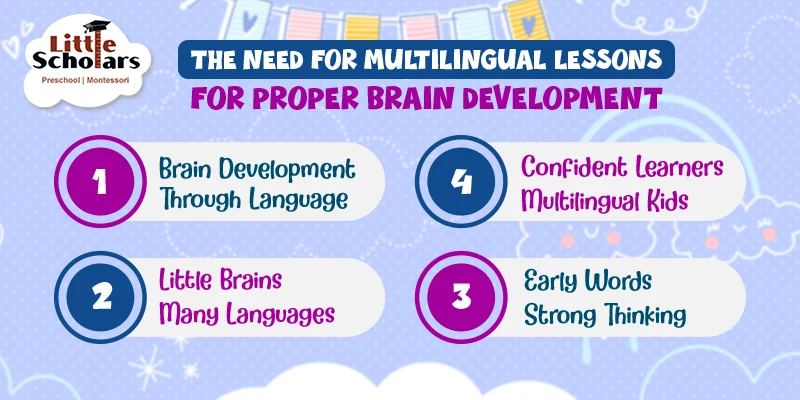
To sum up, multilingual lessons are essential for children from a very early childhood because they build confidence to communicate with peers, strengthen cognitive skills, and can face challenges in the classroom. Thus, preparing children for future academics and being successful in their social circle.

Copyright © littlescholars.org.in | All Rights Reserved. Website Development & Digital Partner – BUSFAM